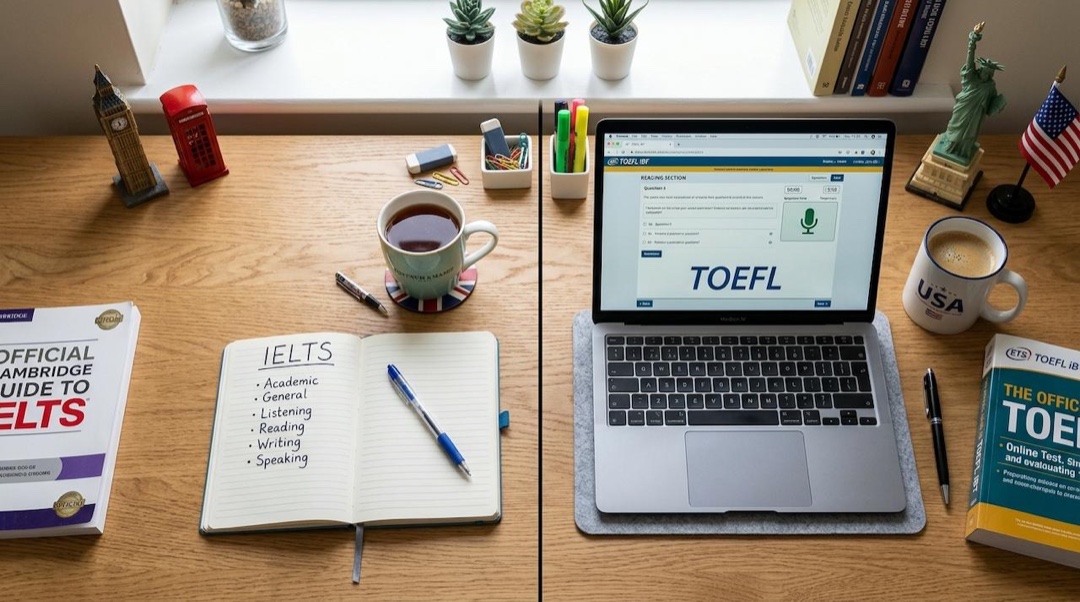
You've decided you need an official English certificate, for study, a visa, or a job. Next comes the question that troubles almost everyone: IELTS or TOEFL? Both are excellent, recognized worldwide, and measure the same skills, but they differ in format, scoring, and the "feel" during the test. Picking the wrong one won't disqualify you, but picking the right one can make it easier to get your best possible result.
In this guide we compare both exams from A to Z: what they are, what each section looks like, how much they cost, how the scores compare, and, most importantly, how to choose the one that fits you best. At the end you'll find answers to the questions I hear most often from students preparing to sit the exam.
What IELTS and TOEFL Are, in Short
Both exams measure your English across four skills: listening, reading, writing, and speaking. The goal is to show that you can study or work in an English-language environment.
IELTS (International English Language Testing System) is a British-Australian exam, jointly run by the British Council, IDP, and Cambridge. It comes in two versions: Academic (for study) and General Training (for migration and work). It's recognized by over ten thousand institutions worldwide.
TOEFL (Test of English as a Foreign Language), in its iBT version, is an American exam run by the organization ETS. It's primarily academic and most widely used at universities in the US, though today it's broadly recognized elsewhere too.
In other words, both lead to the same goal. The difference lies in how you get there.
Both scales can also be translated into CEFR levels (from A1 to C2), which you're probably already familiar with from lessons. A higher IELTS band or TOEFL score corresponds to a C1 level, which to many programs and employers means "an independent and confident user of the language."
Format and Section Breakdown
The biggest practical difference is what the test itself looks like. Here's a quick rundown of both structures.
IELTS
- Listening (around 30 minutes): four recordings, ranging from everyday conversations to academic lectures.
- Reading (60 minutes): three longer texts with a range of task types.
- Writing (60 minutes): two tasks, including describing a chart or table in the Academic version, plus an essay.
- Speaking (11 to 14 minutes): a live conversation with an examiner, in three parts.
The whole exam takes around two hours and forty-five minutes. You can choose the paper or computer version, while Speaking is always done live with a person.
TOEFL iBT
- Reading: several academic texts with questions.
- Listening: lectures and conversations set on campus.
- Speaking: a few short tasks you answer into a microphone, with the recording later scored by raters.
- Writing: tasks where you connect what you've read and heard, plus an independent writing task.
The whole exam is computer-based and today takes under two hours. If you're more comfortable typing than writing by hand, and speaking into a microphone without a conversation partner, the TOEFL format will probably suit you.
One consequence of these differences: on IELTS it helps if you're relaxed talking to a person, while on TOEFL the advantage goes to those who don't mind speaking to a screen, with no one on the other end. Neither is better, but it can tell you which format to try first.
Key Differences at a Glance
- Scoring: IELTS gives a score of 0 to 9 (the so-called band, with halves), while TOEFL scores 0 to 120 points (up to 30 per section).
- Speaking: on IELTS you talk live with an examiner, while on TOEFL you speak into a microphone with no one interrupting.
- Delivery: TOEFL is entirely computer-based; IELTS offers both a paper and a computer version.
- Versions: IELTS has Academic and General Training; TOEFL is primarily academic.
- Accents: in the IELTS listening section you'll hear more British and Australian voices, while TOEFL leans toward North American pronunciation.
None of these differences makes one exam "better." They simply mean one format will feel more natural to some people, and the other to someone else.
Not sure where to start?
Take our free 50-question test and find out your exact level on the CEFR scale. You get the result instantly, and only then do we build a plan.
Take the Free TestCost, Validity, and Recognition
Prices are similar and typically range from around 200 to 250 euros, with variation from country to country. Results for both exams are valid for two years from the test date, so it makes sense to sit the exam close to your application, not too far in advance.
Recognition is very broad for both, but here's the most important practical advice in this whole article: before applying, always check exactly what the institution you're applying to requires. Universities and embassies often specify both the exact exam and a minimum score, and sometimes how old the result is allowed to be. If only one exam is listed, the decision has already been made for you.
Registration is done online through official test centers, and it's smart to book your slot in advance, since popular dates fill up quickly. Results arrive anywhere from a few days to two weeks later, depending on the exam and version, so factor that into your planning ahead of the application deadline.
How Scores Compare and What You Need
Since IELTS and TOEFL use different scales, it helps to know roughly how they line up. These are approximate ranges; ETS publishes the official comparison table:
- IELTS 6.0 corresponds roughly to a TOEFL score of 60 to 78.
- IELTS 6.5 corresponds roughly to 79 to 93.
- IELTS 7.0 corresponds roughly to 94 to 101.
- IELTS 7.5 corresponds roughly to 102 to 109.
As a rough guide, university admission most commonly requires IELTS between 6.0 and 7.0, or TOEFL between 80 and 100, while more prestigious programs and some visas ask for more. But the threshold varies by institution, so always check at the source, not based on someone else's experience.
Also pay attention to the fact that many institutions look not only at the overall score, but also at the minimum per section. It's sometimes possible to have a high enough total and still not pass because, for example, Writing falls below the required threshold. That's why in preparation we don't neglect any part.
How to Choose the Right One for You
If your institution accepts both exams, the choice comes down to a few practical questions:
- What does the institution require? If a specific exam or exact score is listed, the decision is made.
- Which format suits you? A live conversation (IELTS) or speaking into a microphone (TOEFL); writing by hand or typing.
- How confident are you at a computer? TOEFL is entirely on-screen, so typing speed and working with headphones play a role.
- What test dates and locations are available? Sometimes it simply comes down to which exam you can take sooner and closer to home.
The best test is a practical one: take a short practice exam for each and choose the one where you feel more natural and composed. A format that fits you often earns a few precious points.
Common Mistakes in Choosing and Preparing
- Choosing based on "which is easier." The easier one is whichever suits you, and you find that out through a practice test, not from other people.
- Skipping the requirements check. Taking the wrong exam or the wrong version (Academic instead of General) is the costliest mistake.
- Underestimating the Speaking and Writing sections. This is exactly where points are most often lost, and it's the easiest to fix with practice.
- Practicing without a clock. Both exams are a race against time, so practice tests under real conditions are essential.
The good news is that all of these mistakes are easy to avoid with a bit of planning. Checking the requirements takes five minutes, and a practice test another hour, but together they save you months of preparing for the wrong exam.
What Good Exam Preparation Looks Like
Once you know which exam you're taking, preparation stops being general English learning and becomes training for a specific format. That's why targeted preparation often earns more points in less time.
- Getting familiar with the format. We first go through every section and task type, so nothing is new on exam day.
- Section-specific strategies. Every part has its own tricks: how to read quickly, how to structure an essay, how to answer a Speaking task within the time given.
- Working on weaker points. You gain the most where you're losing the most, and that's most often writing and speaking.
- Timed practice exams. Simulating real conditions builds stamina and calms nerves for exam day.
With a clear plan and regular progress tracking, your target score stops being a hope and becomes a predictable result.
Final Thoughts
There's no "better" exam, only a better one for your goal. Once we determine which one you're taking, preparation becomes focused: we work on strategies for every section, task type by task type, and practice exams under real conditions, so there are no surprises on test day.
If you need exactly that kind of targeted preparation, I'm here to help. In English lessons, we build a plan around the exact score you need, with clear progress tracking. The first step is a free test to see where you're starting from.
Frequently Asked Questions

Neither is objectively easier, it depends on you. Those who like a clear structure often prefer TOEFL; those who like a live conversation prefer IELTS Speaking.
To jump half a band to a full band (or ~10 TOEFL points) usually takes 1–3 months of focused preparation, depending on your starting point.
You can, but there's rarely a need. It's better to choose one and commit to it.
It depends on the institution and program, but most commonly IELTS between 6.0 and 7.0, or TOEFL between 80 and 100, is required. More prestigious programs ask for more, so always check the exact threshold on the university's website.
Yes, you can take both exams multiple times and submit your best result. Given the cost and time involved, though, it's smarter to prepare well and sit the exam when you're ready, rather than rely on retakes.