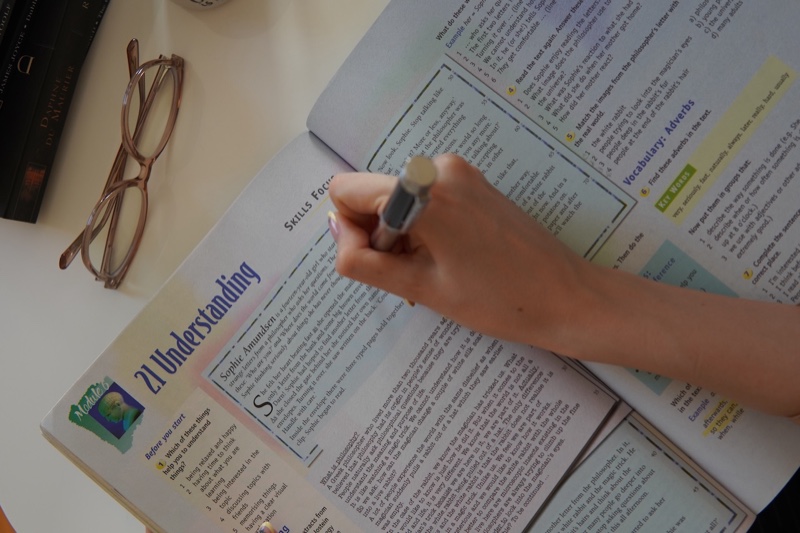

You're 40, 50, maybe more, and somewhere in the back of your mind a voice says: "it's too late, that's for young people." Almost every adult student comes to me with that same doubt. After ten years of working with adults, I can say clearly: it's not too late. In fact, as an adult you have a whole set of advantages that children don't.
In this article we'll break down where the fear of "it's too late" even comes from, what science actually says about learning a language as an adult, what you're better at than a child, and how to get started after a long break without pressure. Whether you're interested in English for work or Spanish for travel and a dream retirement, your age isn't the obstacle you think it is.
Where the Fear of "It's Too Late" Comes From
This fear usually comes from three sources, and none of them is a real obstacle to learning.
- A bad school experience. Many people learned a language through grammar drilling and fear of grades, so it feels like they "have no aptitude" for languages. The problem was the method, not you.
- The myth of the "critical period." There's a belief that after childhood, the brain "closes the door" to languages. That's a half-truth, which we discuss below.
- Comparing yourself to others. It's uncomfortable to make mistakes in front of younger people or children who pick up pronunciation quickly. But progress isn't measured by who sounds prettiest, but by who sticks with it.
Once these three fears are unpacked, a simple truth remains: learning a language is a skill, like driving or cooking, and skills are acquired at any age.
It's worth saying out loud, too: the fact that you opened this article at all means the motivation is there. And motivation is the fuel that children most often lack, while in adults, who choose to learn on their own, it's usually strongest.
What Science Says About Learning as an Adult
The idea that languages are learned "only while we're young" is oversimplified. What research actually shows is quite encouraging for adults.
First, the brain remains capable of forming new connections its whole life. This trait is called neuroplasticity, and it doesn't disappear with age. Learning a new language is even one of the best ways to keep the brain active and sharp.
Second, the so-called "critical period" applies mainly to pronunciation, not to learning ability as a whole. It's true that children pick up a perfect accent more easily, but adults are the ones who master grammar, vocabulary, and sentence structure faster, because they rely on an already-developed language system in their native language.
In other words, you might not sound like a native Londoner or a Madrileño, but you'll get to the point where everyone understands you and you communicate fluently much faster. And that's the goal of almost every adult student.
Third, learning a language is also exercise for the brain. Regularly engaging memory, attention, and new patterns keeps the mind active, and research links learning and using a second language to slower cognitive decline later in life. What you invest in a language comes back to you through mental clarity, too.
What Adults Do Better Than Children
Age brings experience with it, and experience is a serious advantage in learning a language. Here's what you specifically do better than a child:
- Discipline and focus. You know why you're learning and can stick with it even when it's not fun, which is hard for children.
- Context and experience. You attach new knowledge to what you already know about the world, so you grasp abstract concepts and grammatical logic faster.
- A clear goal. Travel, work, talking to grandchildren abroad, or your favorite show without subtitles: your motivation is concrete and personal.
- Strategy. You know how to study smart, not just a lot, and to choose what you actually need.
That's why adults with a good plan often outpace a teenager who's learning "because they have to." Motivation and method outweigh youth.
Not sure where to start?
Take our free 50-question test and find out your exact level on the CEFR scale. You get the result right away, and only then do we build a plan.
Take the free testThe Myth That "Kids Learn Faster"
This is probably the most persistent myth, and it's worth unpacking fully. Over the long run, children really do sound more natural, above all in pronunciation. But "sounds more natural" isn't the same as "learns faster."
The truth is that in the first few months, adults usually progress faster than children. You understand grammatical logic, you have a rich vocabulary in your native language to lean on, and you can consciously practice what isn't going well. A child reaches the same level, but it takes far more hours of exposure.
What looks like "ease" in children is actually an enormous amount of time: a child is immersed in the language all day, for years. Once an adult secures regular exposure and practice, that advantage melts away fast. For a practical goal, your age is an ally, not a burden.
There's also a hidden advantage for the adult learner: you know how to ask for an explanation. When you don't understand something, you ask a question and get a rule that saves you hours of guessing. A child doesn't have that option, they have to figure everything out from pure exposure.
The Most Common Worries Among Adult Students
Besides "it's too late," I hear three other worries. All three have a solution.
"I don't have time"
You don't need a lot of time, you need regular time. Fifteen minutes a day plus two lessons a week is entirely enough for noticeable progress. Better a little and steady than a lot with interruptions.
"My memory isn't good"
Memory doesn't decline as much as you think, it just needs context. Words learned through sentences, situations, and topics that interest you stick around far better than a bare list. Method fixes what you're blaming on age.
"I'm embarrassed to make mistakes"
A mistake is a sign you're learning, not that you're not capable. In a one-on-one lesson there's no audience or grades, just you and a safe space to practice. That's exactly why adults who start one-on-one lose their nerves the fastest.
"I'm afraid I won't stick with it"
Persistence doesn't come from willpower, it comes from a system. Small, regular steps and a clear goal keep you in rhythm even when motivation wavers. There's also a teacher who gently keeps you accountable, which for many adults is the crucial difference compared to an earlier attempt at learning alone.
Why Learning a Language Pays Off Especially in Your Mature Years
Beyond simply being possible, learning a language in your mature years brings special benefits you might not even be aware of.
- Travel becomes richer. Once you start speaking, travel stops being something you watch from the sidelines and becomes a real encounter with people and culture.
- Closer family ties. Many people learn a language because of a daughter-in-law, son-in-law, or grandchildren growing up abroad. A shared language is the loveliest bridge.
- Personal challenge and confidence. Little else restores that feeling of progress the way seeing, month after month, that you can now do something you couldn't before.
- Setting a good example. When children or grandchildren see you learning in your mature years, they get the strongest possible message that there's no deadline on knowledge.
In other words, it's never "just" too late to start. Often, it's exactly the right time.
What a Lesson Built for an Adult Student Looks Like
The reason an earlier attempt may have failed is rarely you, and much more often the approach, which wasn't built for adults. A lesson built for an adult student differs from a school one in a few key ways:
- Topics from your own life. You're not learning about invented characters from a textbook, but about your job, travels, and interests. What you need is exactly what you practice.
- Focus on speaking. You talk for most of the lesson, because speech is learned by speaking, not by listening to lectures about grammar.
- No pressure or grades. There are no tests or audience, just a safe space where mistakes are part of the process.
- Flexible pace. The rhythm adapts to your responsibilities and your day, not the other way around.
That's exactly why adults who previously "gave up on languages" are often surprised how quickly things click once the method fits their life.
How to Start After a Long Break
The good news is you rarely start from zero the way you think. Your school knowledge is there, just "dormant," and it wakes up faster than it was learned the first time. Here's how to get started without pressure:
- Take a short level test. To see what's left and exactly where to build from, instead of guessing.
- Start with small, regular steps. Short daily sessions build momentum. More on that in the article 5 habits that speed up language learning.
- Speak from the first week. Don't wait until you feel "ready." If speaking feels hard, see why in the article why I understand a language but can't speak it.
- Set a realistic goal with a deadline. Knowing how many hours sit behind each level helps keep your expectations healthy; the article how long does it take to learn a language covers this.
So your expectations are realistic, here's what the start after a break usually looks like:
- First weeks: old knowledge wakes up, familiar words and basic phrases come back.
- First month: initial nervousness fades, simple sentences come together more and more easily.
- After 2 to 3 months: you hold short conversations and feel the first clear shift in speaking.
Final Thoughts
The best time to start was ten years ago. The second best is today. Age isn't the obstacle, it's an excuse that often hides an old fear from school. Lack of the right approach is an obstacle, but it's one that's easily solved.
If you'd like to start with a plan built for an adult student, I'm here to help. Through English lessons and Spanish lessons we build the pace and topics around your life and goal, and the first step is a free test to see where you're starting from.
Frequently Asked Questions

Absolutely. Many of my most persistent students are exactly this age, and with a clear goal and regular work they progress wonderfully.
"Talent" is mostly a sum of method, consistency, and confidence. With the right approach, practically anyone can learn a language.
Rarely literally from zero. Passive knowledge "wakes up" quickly. A level assessment shows us exactly where to start building from.
A perfect native-like accent is harder after childhood, but clear, understandable pronunciation is entirely achievable at any age. With listening and repetition practice, progress is fast, and the goal isn't to hide your origin, but to be easily understood by everyone.
With two lessons a week and short daily practice, the first noticeable shift in speaking usually comes after 2 to 3 months. You can find detailed estimates by level in the article how long does it take to learn a language.